The future of the native red squirrel is a little uncertain in Britain because of the expansion of the introduced grey squirrel. Grey squirrels out compete the red, being larger, living in higher densities and being able to eat seeds such as acorns before they are ripe (while a red can’t). Greys also carry the squirrel-pox virus which will kill reds but not greys. Habitat loss is also a factor in the decline of the red squirrel.
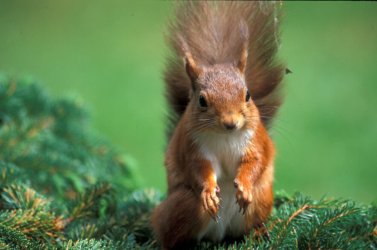 Red squirrels live in trees, and will utilise all types of woodland. They reach higher densities in mixed or broadleaved woodland due to the wider range of food availability. However, they are increasingly becoming restricted to large conifer woodland because of the grey squirrel. Red squirrels build nests, usually in the forks of trees tight against the tree trunk, known as dreys. These are dense balls of interwoven twigs about the size of a football, lined inside with soft materials such as mosses, leaves, and grass. They are primarily seed eaters, but also eat fungi, shoots, fruits of shrubs and trees, bulbs, flowers, and sometimes birds eggs.
Red squirrels are fully protected under the Wildlife and Countryside Act 1981. This makes it an offence in Britain to deliberately capture, injure, or kill them, or damage, destroy or obstruct their breeding or resting places. It is also an offence to disturb them in their breeding or resting places.
If works are likely to affect habitat where red squirrels might be present, then there are a number of ways to survey for red squirrels:
- Visual surveys – looking for direct sightings.
- Hair-tube surveys – baited drain pipes with sticky take to collect hairs.
- Drey Counts – counting active dreys.
- Feeding sign surveys – assessing pine cones that have been eaten by squirrels.
- Whole maize bait – squirrels remove the germ from the maize grain and discard the rest intact.
All of these methods have their limitations. The latter three methods can not differentiate between red and grey squirrels. Hair-tube surveys are labour intensive and visual surveys have poor results in dense conifer plantations.