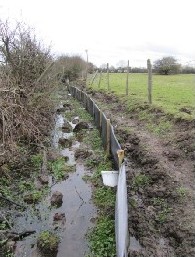
 If GCN are to be removed from the site in preparation for a development, the site is usually surrounded by a drift fence to ensure no migration occurs into the site from the surrounding habitats. To do this, a suitably experienced ecologist must first check the site boundary where the fence will be located to ensure that there are no newts present. Erection of the fence may then commence under supervision of an ecologist.
The fence must be 50cm above ground with a 10cm under-curl away from the fence underground, and an over-curl of 20cm at the top. Once this is installed, pitfall traps (buckets without a top lip) can be sunk flush into the ground directly against the fence. Buckets must have some drainage holes in the bottom, a mammal ladder, a float, and some vegetation (or some form of refuge), and be located approximately 5 metres apart.
Carpet tiles may also be used as refuges as they provide humid conditions for newts. Traps must be checked daily before 11am, and notes made as to the number, sex, location and life stage the newt was in. Captured newts are relocated to the receptor area as soon as possible, and a permanent fence erected to prevent further migration into the development when it is finished.
Translocations can continue through to October if night-time temperatures remain above 5°C, however no surveys are undertaken over the winter as newts hibernate over this period, or during the summer months when it is too hot. It is important therefore to ensure that surveys commence in plenty of time to allow sufficient visits are made and to prevent any delays to development schedules.